
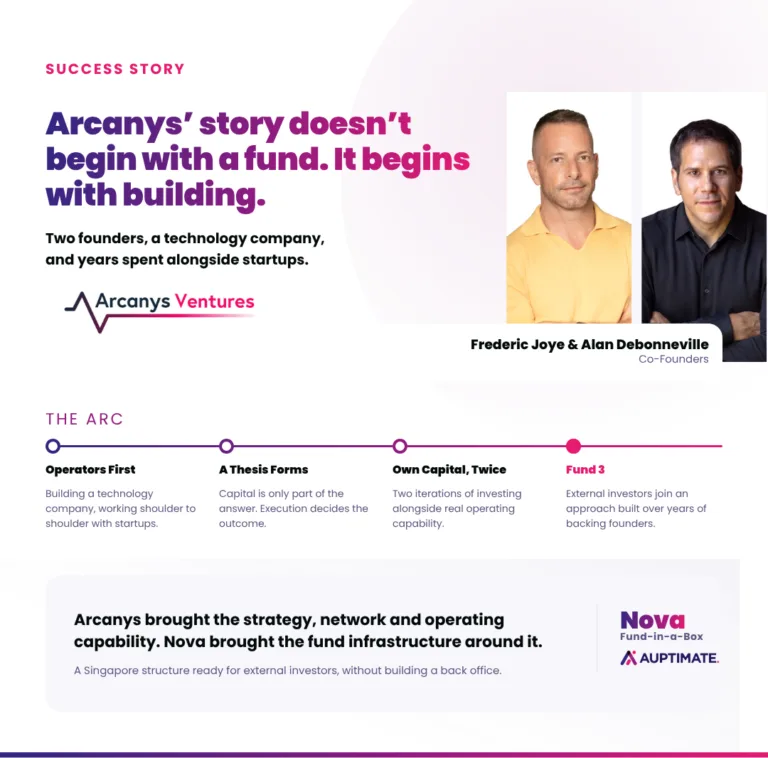
Arcanys built startups for 16 years. Now
it’s building its next fund.
Before Arcanys became an investor, it spent years on the other side of the table: building.
Longtime friends Alan Debonneville and Frederic Joye founded Arcanys in 2010 after establishing a technology operation in Cebu, Philippines. What began as an internal development team soon attracted interest from entrepreneurs in their network who needed
engineering talent of their own. That demand became the foundation for Arcanys.
Over the next 16 years, the business grew into a 360+ person technology company that has worked with more than 200 companies. Its engineers and product specialists have spent years inside the practical realities of building technology businesses: hiring teams, shipping products, managing roadmaps and making decisions with finite resources.
That proximity to founders eventually shaped another part of Arcanys’ business. The team repeatedly saw that successfully raising capital did not necessarily solve what came next.
What happens after the round closes?
A funding round gives a startup more runway, but it does not decide how that runway gets used. Founders still need to hire the right people, decide what to build, establish the right technical foundations and get products into customers’ hands.
For Arcanys, this was familiar territory. Its teams had spent years working alongside technology companies on precisely these challenges.
That experience gradually shaped its approach to investing. Rather than contributing capital alone, Arcanys could combine investment with the operating capabilities it had already spent years building. Depending on what a company needed, that could include engineering and product expertise as well as technical and operational support from across the wider Arcanys organisation.
The shift also changed Arcanys’ relationship with the companies it worked with. It was no longer simply providing a service. As an investor, it could participate in the long-term outcomes of the businesses it was helping to build.
But Arcanys did not begin by setting out to become a conventional fund manager.
Investing first, building the fund later
Arcanys tested the approach with its own money. Across Funds 1 and 2, Arcanys deployed USD 15 million of its own capital into 35
companies. Those years gave the team an opportunity to develop its investment process while learning where its operating model could have the greatest effect.
Over time, those investments grew were separated into what Arcanys now refers to as Fund 1 and Fund 2.
For Fred, Fund 1 was very much a learning experience. It gave the team an opportunity to understand how its investment model worked in practice and where its operating capabilities could have the greatest impact.
Those lessons informed Fund 2, where the team refined its approach and continued investing in the companies it believed in. Together, the two periods established benchmarks Arcanys could use to assess its progress and shape what came next.
The results also gave the team evidence that the model was developing. Arcanys reports that 90% of companies across its first two funds were still operating at year four. It also reports that 80% of portfolio companies have subsequently raised capital from external investors, while 72% of the portfolio companies eligible for a new valuation have been marked up through externally led rounds.
The experience also influenced how the team evaluates potential investments. Having spent years inside technology businesses, Arcanys can look beyond a company’s pitch and consider how the product is actually built, the strength of its technical foundations and whether its team can translate plans into execution.
In some cases, Arcanys’ relationship with a company begins years before an investment is made in Fund 3. Arcanys may already have invested its services and decides to make a follow-on investment and brings it then to the fund as a much more de-risked investment. In
such cases, Arcanys’ teams and co-founders have already worked alongside the founders, helped build the product. This gives Arcanys a longitudinal, first-hand view of how a company executes: how its founders make decisions, how its technology performs and how
its team responds when plans meet reality.
It does not apply to every investment. But where it does, Arcanys makes investment decisions for Fund 3 using operating evidence accumulated over years, rather than relying solely on the snapshot available through a conventional due-diligence process. Very few
early-stage investors are positioned to develop that depth of knowledge before investing.
By the time Arcanys began thinking about its next chapter, it had years of operating experience and two investment portfolios behind it. What it did not yet have was a formal fund structure designed to bring external investors into the model.
That is where Fund 3 is different.
Opening the model to external investors
Fund 3 represents an important transition for Arcanys. Instead of investing solely from its own balance sheet, the team is opening its investment strategy to external limited partners (LPs).
The underlying philosophy remains familiar. Arcanys wants to invest in early-stage technology businesses where its experience as an operator can complement its role as an investor. It is an approach rooted in a simple observation from years spent working alongside
startups: capital and execution are closely connected.
For external LPs, however, operating a fund brings a different set of requirements. Investor onboarding, administration, governance, reporting and regulatory obligations all sit alongside the work of finding and supporting companies.
Arcanys knew how it wanted to invest. Building the infrastructure around a fund was new territory.
As Fred puts it:
“We knew how we wanted to invest, but we didn’t know much about setting up a fund. We researched and found Auptimate. They gave us the easiest way to put the right structure around what we were already doing, with the VCC sub-fund solution ultimately making Singapore the right fit for us.”
Finding the right structure for Fund 3
As Arcanys researched its options, Singapore and Hong Kong emerged as potential jurisdictions for the new fund. During that process, the team found Auptimate and began exploring how Nova could support the structure it needed.
Arcanys ultimately chose Singapore and Auptimate’s Nova, Fund-in-a-Box solution. Nova is designed for first-time and emerging fund managers that want to establish a Singapore fund without independently assembling all the infrastructure and service providers
involved in running one.
For Arcanys, one aspect was particularly relevant: the ability to operate through a sub-fund of an existing Singapore Variable Capital Company (VCC). Instead of incorporating and operating a standalone VCC, Arcanys could establish Fund 3 within an existing fund structure, with the required operational and regulated infrastructure around it. That separation allows each side to focus on its role. Arcanys remains responsible for its investment strategy, identifying and assessing opportunities, constructing its portfolio and working with its investors and portfolio companies.
The fund structure provides the regulated framework, governance, administration and oversight needed around those activities. For Arcanys, it meant the team did not have to become experts in building fund infrastructure before it could take the next step in its investment journey.
A fund that started long before the fund
Fund 3 may be the first time Arcanys is bringing external LPs into its investment model, but the thinking behind it has been developing for much longer.
Arcanys began as an operator. Years spent building technology products gave its team a close view of the challenges founders encounter after raising capital. That experience led Arcanys and its founders to begin investing their own money, learning through their first portfolio and refining their approach through the second.
Now, Fund 3 puts a formal fund structure around that experience. Nova plays a supporting role in that next chapter by providing the fund infrastructure Arcanys needs as it moves from investing its own balance-sheet capital to managing a strategy that includes external LPs.
The investment proposition itself remains rooted in something Arcanys has been doing since 2010: working closely with technology companies and helping founders turn resources into products and businesses that can grow.
Sixteen years later, Arcanys is approaching that work from both sides of the table, as an operator and an investor.
Interested in investing with Arcanys?
If you’d like to learn more about Arcanys Ventures, its investment approach or Fund 3, you can reach out to the team at fred@arcanys.com