

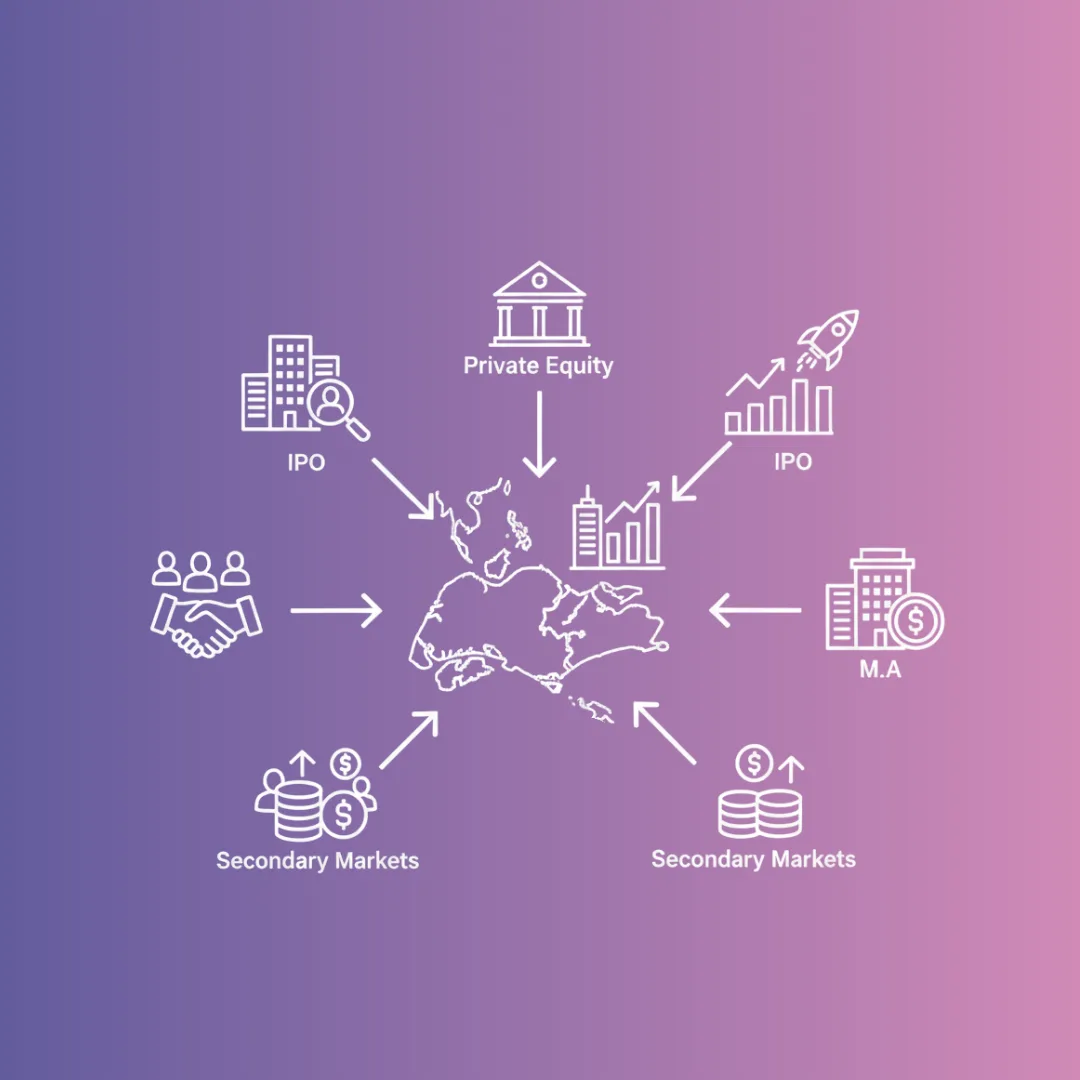
For founders and investors in Singapore, the traditional exit routes—that dream IPO listing or a neat M&A sale to a corporate giant—have all but dried up. The Southeast Asia IPO market just hit its lowest capital raised in nine years, and M&A volume has been stuck in neutral for two straight years. The liquidity pressure has never been higher.
But where one door slams shut, a bigger one swings open. A new, powerful buyer has stepped into the void: Private Equity. This analysis, based on the State of Exits in Southeast Asia, confirms that Singapore’s private equity exit strategies are now the dominant force, evidenced by the staggering market surge.
Here’s how the ecosystem is reshaping, and what founders, syndicate leads, and LPs need to know to secure their returns.
Why traditional exits fail Singapore founders
Markets tightened, public markets shrank. The report shows VC exit activity jumping between tiny quarters (Q4 2021 spike, then slim Q1-Q2 2025 activity) and reveals that strategic M&A deal count fell and median deal sizes shrank (median deal US$13.7m).
Those patterns leave founders holding mature companies without clear liquidity. Institutional buyers now demand profitability or large, predictable cash flows before bidding, the valuation gap widens and exits stall.
Private equity is the new liquidity engine
The report clearly shows the Q2 2025 split: Private equity produced the largest exit value that quarter (PE exit value of US$5.4B), while VC exits remained small (US$1.3B).
That divergence signals a structural shift. PE deploys larger cheques, pursues buyouts and secondaries, and generates concentrated exit value, exactly the liquidity Singapore needs now.
Why PE wins today
- PE providers chase control and operational improvements, so they target later-stage firms with predictable unit economics.
- PE funds raise bigger follow-on vehicles and continuation vehicles to hold winning assets longer and then sell on better terms.
- Sectors that attract PE in Singapore include digital infrastructure, healthcare, and software services, areas with defensible cash flows.
Serious PE deals demand serious structure. Schedule a call with us and build your Singapore SPV with clear diligence and confidence.
How PE liquidity actually arrives: secondaries, CVs, and buyouts
PE delivers liquidity through several predictable channels. Your report highlights the growing share of secondaries and GP-led continuation vehicles. Those structures let LPs crystallize value while GPs keep runway for breakout winners.
Secondaries also let VCs rotate capital earlier than a full IPO or strategic sale would allow. In ecosystems with weak IPO windows, these mechanisms act as emergency valves, restoring flow to aging portfolios.
PE’s checklist: What companies must prove
PE buyers change how investors evaluate startups.
Profitability and cash flow
PE values EBITDA and predictable free cash flow over aggressive top-line growth alone.
Clean finance and governance
PE teams audit, then retool finance functions. Prepare audited books, clarify the cap table, and identify strong board candidates.
Scalability with margin expansion
Demonstrate how incremental revenue translates to operating leverage — a core PE return lever.
Quick playbook for founders
- Prepare 3-year EBITDA forecasts and sensitivity cases.
- Close any loose shareholder agreements and fix option pool mechanics.
- Run a dry run due diligence checklist (legal, tax, IP).
- Map a continuation vehicle vs. full secondary trade decision tree.
- Line up a capital-efficient growth plan that proves unit economics.
Bain flagged the same macro pressure, “Following three tough years for exits, GPs face significant pressure to sell companies in their aging portfolios.” That pressure drives the secondary and buyout activity we see in Singapore today.
Final Thoughts
Singapore private equity exit strategies no longer represent a niche alternative; they now form the backbone of liquidity in a market where IPOs and strategic M&A underperform.
Expect PE to keep setting valuation anchors, expand secondaries and continuation vehicles, and demand PE-grade governance and cashflow from founders. For founders, the path forward includes tightening unit economics, cleaning the cap table, and treating exit readiness as an operating priority.
Ready to plan a PE-friendly exit? Book a call with us or get in touch with us at info@auptimate.com, and one of our experts will be more than happy to help.
