


While the slow grind of the exit market may be over, it’s not because of the IPO’s comeback, but instead, the smartest money in venture capital has found the exit ramp: the secondary VC transactions market. Data proves that with traditional M&A constrained and the public window shut, investors are making their own moves to generate returns.
The surge in these deals is a calculated strategic response to two forces: the need for liquidity and the maturation of entire VC fund vintages. From fund lifecycles fuelling urgent GP demands to the strategic use of partial exits, alternative routes are springing open.
Here’s what this shift reveals about modern investor strategy and what syndicate leads, investors, and SPV platforms need to know about the new reality of secondary sales.
Fund Lifecycles and Liquidity Demand Driving Secondary Transactions
The most significant strategic force driving the surge in secondary VC transactions is a simple reality: the clock is hitting zero. Every VC fund has a 10-year lifecycle, and the first major wave of capital raised during the 2015 to 2018 boom years is officially running out of runway.
The data confirms this pivotal strategic shift, illustrating the synchronized pressures and emerging opportunities reshaping the VC landscape.
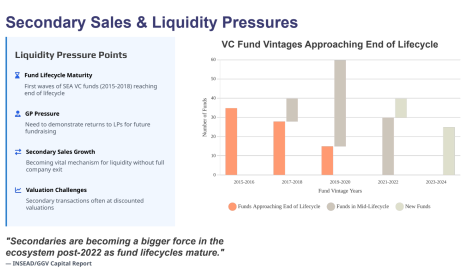
Graph from State of Exits in SouthEast Asia 2025 Report by Retvrn
This isn’t just an administrative headache; it’s a high-stakes fundraising problem. As the report confirms, these vintages are nearing their end, forcing General Partners (GPs) to deliver.
GPs face intense “GP Pressure,” and they must demonstrate real cash-on-cash returns (DPI) to their Limited Partners (LPs) if they ever want to raise their next flagship fund. With traditional exits like IPOs still sluggish, the only viable mechanism to unlock that required capital is selling existing stakes on the secondary market.
This urgency forces a strategic decision. Better a realized return now, even at a discounted valuation, than a paper return that risks stranding the next fund. It’s a pure, self-preservation move by the fund manager.
The Strategic Role of Partial Exits
GPs use partial secondary sales as a surgical tool. They sell a sliver to return cash, improving DPI, while retaining a majority stake to capture future upside if the company executes. This “some now, more later” approach converts paper value into demonstrated cash performance without forcing a fire sale.
Why partial exits matter
- They preserve managerial control while unlocking liquidity.
- They shorten payback timelines for LPs.
- They reduce tail risk for funds approaching close.
In a 2024 report, Bain’s analysis captures why secondaries scale, “At the moment, secondary transactions provide only about $120 billion in liquidity annually for an industry with over $20 trillion in assets under management globally (this vs. US public equity markets, which turn over more than $200 billion in assets daily).”
Need a clean, compliant SPV structure for secondary VC transactions? Schedule a call with our expert to design a setup that enables liquidity, optionality, and tax efficiency.
How Strategic M&A Relates to Alternative VC Exit Strategies
With IPO markets stuck in neutral, strategic acquirers never stopped looking for ways to grow; they changed how they do it. M&A (Mergers and Acquisitions) has shifted away from massive deals and toward smaller, calculated acquisitions that set the foundation for future consolidation.
The shifting volume of transactions clearly illustrates why investors are bypassing traditional routes in favor of alternative strategies.

Graph from State of Exits in SouthEast Asia 2025 Report by Retvrn
This shift naturally aligns with the rise in secondary VC transactions. Instead of waiting for a complete exit, a GP can sell a meaningful stake to an institutional secondary buyer with the appetite to support the company through a later strategic acquisition or eventual buyout.
That injection of aligned, long-term capital often makes the cap table cleaner and the company more attractive to future acquirers.
In practice, this plays out in several ways:
Regional consolidation:
Local incumbents acquire companies to gain scale, while secondary VC transactions quietly rebalance ownership toward strategic players who want influence ahead of future consolidation.
Cross-border M&A:
International acquirers use secondary transactions to secure an initial position in a target company without committing to a full buyout on day one. This gives them optionality as they evaluate market fit.
Management buyouts and continuation vehicles:
When teams want to regain control or extend runway, secondary buyers fund buybacks at reset valuations. This creates a cleaner, more aligned cap table for a later strategic exit.
These dynamics illustrate how GPs are increasingly using structured secondaries to stabilise ownership and extend runway.
Quick Takeaways and Action Steps
- For GPs: Use GP-led secondaries or continuation vehicles to manage vintage-driven liquidity and protect fundraising momentum.
- For LPs: Evaluate secondaries as a reliable way to recycle capital without hysterical markdowns.
- For Syndicate leads & SPV platforms: Build workflows that support partial exits, due diligence, and rapid negotiation of transfer terms.
Final Thoughts
Secondary VC transactions are no longer a niche workaround; they’re an essential part of modern exit playbooks. Funds facing synchronized lifecycle pressure will keep leaning on secondaries to show cash returns while buyers hunt high-quality positions at attractive bases.
For syndicate leads and SPV platforms, the imperative is practical: build legal, tax, and operational capacity to execute secondaries cleanly and quickly.
Ready to structure an SPV for a secondary deal? Book a call with us or get in touch with us at info@auptimate.com, and one of our experts will be more than happy to help.
