

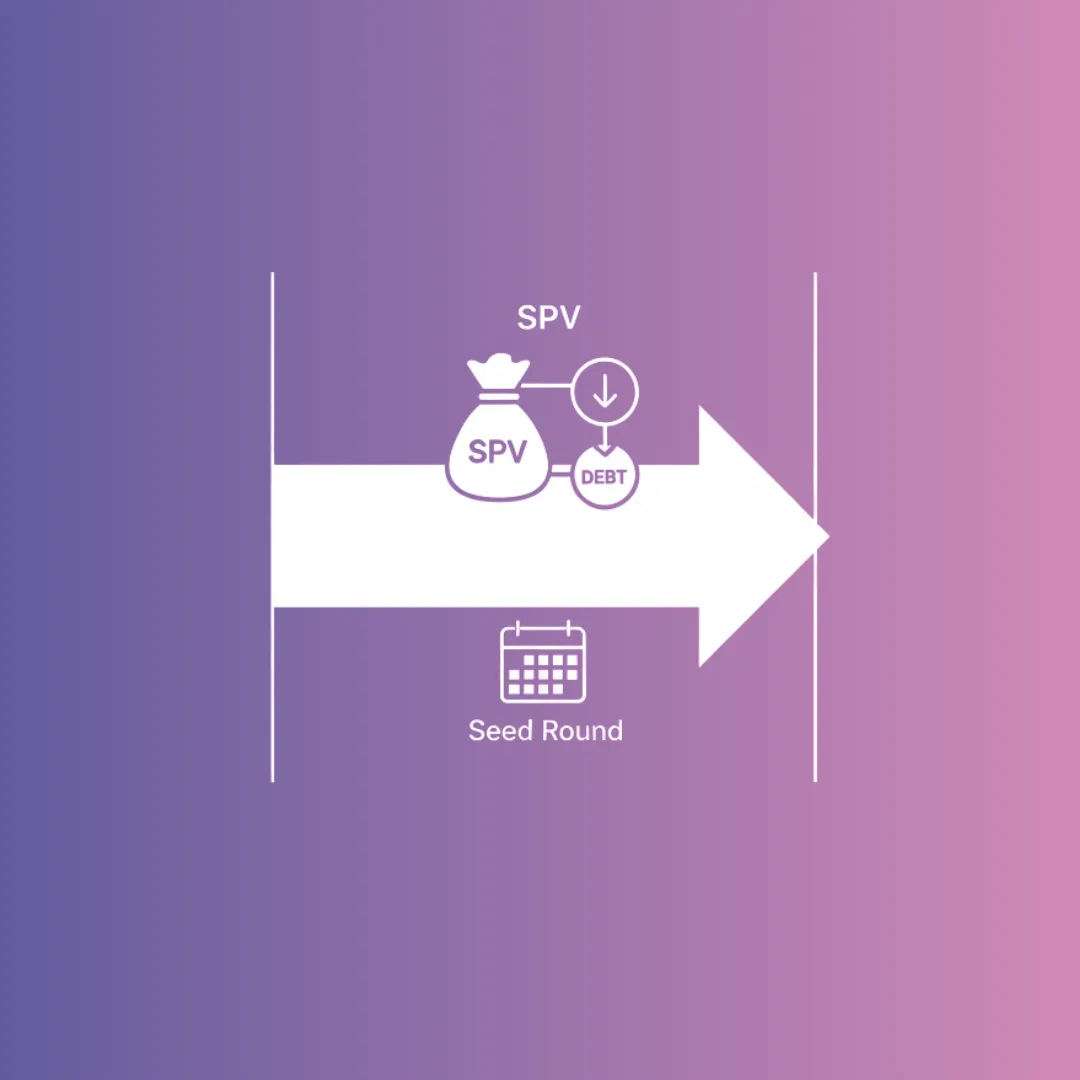
Convertible notes are the fast lane for early-stage angel investment, letting investors back startups without getting bogged down in valuations or complex equity terms. When routed through SPVs, they bring added efficiency, pooled capital, and strategic flexibility.
Pooling capital via SPVs, navigating conversion timing, discounts, and valuation caps are just a few of the nuances that can shape outcomes for syndicate leads, angel investors, and early-stage startups. Here’s a closer look at how these structures work, why they’re used, and what to watch for when investing through an SPV.
How Does a Convertible Note Work?
A convertible note starts life as debt, not equity. Investors lend capital to a startup with the understanding that the loan will convert into shares when a predefined conversion event occurs, most commonly a future priced equity round.
Until that conversion happens, the note behaves like a traditional loan. It accrues interest and carries a maturity date. If no qualifying financing occurs before maturity, the parties must renegotiate terms, extend the note, or, in rare cases, repay it.
When a conversion event does occur, the amount converted into equity includes both the original principal and any accrued interest. The conversion price is determined by one of two mechanisms, sometimes both:
- Valuation cap: Sets a maximum valuation for the company at which the note converts. If the startup raises a priced round above that cap, noteholders convert as if the valuation were lower, preserving early upside.
- Discount rate: Grants noteholders a discounted share price relative to new investors in the priced round, typically ranging from 15–30%.
If both a cap and a discount exist, the note converts using whichever results in the more favorable outcome for investors.
Unlike SAFEs, convertible notes do not always convert automatically at every priced round. Many include thresholds that define what qualifies as a “qualified financing,” such as a minimum capital raise amount.
Founders gravitate toward convertible notes because they close quickly, reduce upfront legal costs, and delay valuation discussions. Angels use them because they reward early risk with preferential economics, interest accrual, and stronger downside protection as debtholders.
How SPVs Invest Through Convertible Notes
When angel syndicates invest through a convertible note, they often do so using a Special Purpose Vehicle (SPV) to aggregate capital and simplify execution. An SPV is a standalone legal entity created for a single investment purpose. In this case, issuing one convertible note to a startup.
Importantly, an SPV is legally distinct from its sponsors and investors. As Investopedia explains, SPVs “operate as separate legal structures from the parent company, holding their own obligations, assets, and liabilities,” allowing them to be bankruptcy-remote, meaning their financial fate is isolated from that of other entities.
The process typically unfolds as follows. Individual angels commit capital into the SPV, becoming limited partners or members. The SPV then deploys that pooled capital to the startup in exchange for a single convertible note. That note accrues interest and later converts into equity when a qualified financing event occurs.
From the startup’s perspective, this structure is clean and efficient. The cap table reflects one investor—the SPV—rather than dozens of individual angels. From the investors’ side, the SPV centralizes administration, legal documentation, and ongoing management under a lead.
Crucially, the SPV also isolates risk. Any losses remain contained within the vehicle, shielding investors’ broader portfolios from direct exposure. This combination of cap table simplicity, risk isolation, and administrative efficiency is why SPVs have become the default structure for syndicated convertible notes angel investment.
Leading or joining an angel syndicate using convertible notes? Schedule a call with us to see how SPVs can help you pool capital, isolate risk, and execute convertible note investments cleanly.
Why Angel Syndicates Use SPVs for Convertible Note Deals
Angel syndicates rely on SPVs for convertible note deals because they solve problems on both sides of the table, operationally for founders and strategically for investors.
Key Benefits of SPVs for Angel Syndicates
Simplified Capitalization (Cap) Table
From a founder’s standpoint, this is the single most significant advantage. Even if an SPV represents 50 angel investors, it shows up as one line item on the cap table. That simplicity reduces friction in future funding rounds and makes the company far more attractive to institutional investors.
Pooling Capital and Access to Deals
SPVs allow angels to combine capital and write larger checks. This unlocks access to competitive or oversubscribed rounds that individual angels could not enter alone. Larger check sizes also strengthen negotiating leverage around valuation caps, discounts, and information rights.
Risk Isolation and Liability Protection
Because the SPV is a separate legal entity, all financial exposure stays within that vehicle. If the startup fails, losses do not spill over into investors’ personal assets. This “bankruptcy-remote” feature is a core reason SPVs are favored in structured angel investment.
Streamlined Administration and Due Diligence
The syndicate lead manages sourcing, diligence, documentation, and ongoing communication with the startup. Individual angels benefit from professional deal execution without the overhead of managing each investment independently.
Flexibility for Convertible Notes
Convertible notes pair naturally with SPVs. The syndicate acts as a single counterparty to the startup, simplifying debt issuance today and equity conversion later, especially during a priced round when clean execution matters most.
Track Record Building
For lead angels and emerging fund managers, running SPVs creates a visible performance history. That track record often becomes the foundation for raising larger funds or institutional capital down the line.
Final Thoughts
Convertible notes remain a powerful tool in early-stage angel investment, but their real leverage emerges when paired with a well-structured SPV. Together, they allow founders to raise capital quickly while keeping cap tables clean, and enable angel syndicates to pool capital, manage risk, and negotiate stronger economics.
Still, success depends on execution. Misaligned maturity dates, poorly defined conversion triggers, or unclear SPV governance can create friction at the exact moment a company should be accelerating toward its next round. For founders and angels alike, understanding how convertible notes angel investment work within SPVs is no longer optional; it’s foundational.
Looking to structure your next angel round with confidence? Book a call with us or get in touch with us at info@auptimate.com, and one of our experts will be more than happy to help.
