

Create an SPV in Singapore or Cayman
Choose the Right Structure for Your Investors, Strategy, and Scale

Setting up an SPV is not just a legal decision. It directly affects how efficiently you raise capital, how investors understand the structure, and how smoothly you operate across deals.
The question is not simply Singapore or Cayman.
The question is which SPV structure best fits your investor base, transaction profile, and execution needs.
At Auptimate, we support SPV formation for globally active operators, helping syndicate leads, fund managers, and family offices choose the right structure for cross-border investing without unnecessary operational friction.
Not sure which fits your LP base?
→ Book a call and we’ll map your investor profile to the right structure.
Singapore vs Cayman: A Practical Comparison
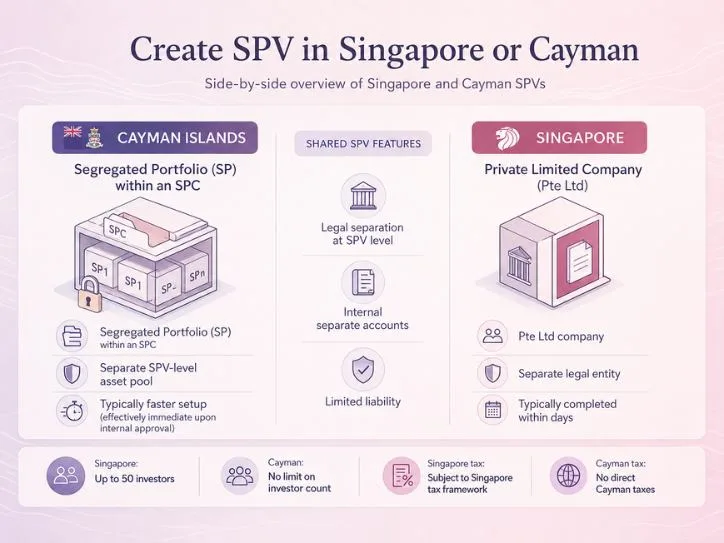
Both Singapore and Cayman are established jurisdictions for SPVs. The key is to compare the SPV itself on a like-for-like basis.
In Singapore, the standard SPV is typically a Private Limited Company (Pte Ltd).
In Cayman, the standard SPV is typically a Segregated Portfolio (SP) within a Segregated Portfolio Company (SPC).
In both cases, one SPV is legally separate from another SPV. Within each SPV, assets can also be tracked and distinguished through internal separate accounts and accounting records.
| Feature | Singapore SPV | Cayman SPV |
|---|---|---|
| Legal Structure | Private Limited Company (Pte Ltd) | Segregated Portfolio (SP) within an SPC |
| Asset Segregation | Legal separation at the SPV level, with internal separate accounts and accounting segregation within the SPV | Legal separation at the SPV level, with internal separate accounts and accounting segregation within the SPV |
| No. of Investors | Up to 50 investors | No limit on number of investors |
| Setup Speed | Typically completed within days | Typically completed very quickly once approved internally |
| Tax Treatment | Subject to Singapore tax framework, with any applicable exemptions | No direct Cayman taxes on income, capital gains, or distributions |
| Banking Partner | Finmo | Clara |
| Governing Law / Framework | Governed under Singapore company law and the Singapore regulatory framework applicable to the structure | Governed under Cayman Islands company law and the statutory framework applicable to segregated portfolios |
Both structures are used across venture, private equity, and credit strategies. The choice of structure depends on the specific requirements of the investment, investors, and operating preferences.
Singapore SPV
A Singapore SPV is typically established as a Private Limited Company (Pte Ltd). This is the standard Singapore SPV structure and is widely understood by founders, operators, and investors.
Each Singapore SPV is a separate legal person. That means one SPV is legally distinct from another. Within the SPV itself, assets and liabilities can also be tracked using internal separate accounts and accounting records where relevant.
Key Characteristics
- Private company structure
- Up to 50 investors
- Separate legal person under Singapore law
- Internal separate accounts and accounting segregation within the SPV
- Integrated banking via Finmo
Cayman SPV
A Cayman SPV is typically structured as a Segregated Portfolio (SP) within an SPC. In this structure, the SPV is the segregated portfolio itself, not the SPC.
Each Cayman SPV is legally distinct from another segregated portfolio. Within the SPV, assets and liabilities can also be managed through internal separate accounts and accounting records where relevant.
Key Characteristics
- Segregated Portfolio structure within an SPC
- No restriction on number of investors
- Separate statutory pool of assets and liabilities at the SPV level
- Internal separate accounts and accounting segregation within the SPV
- Integrated banking via Clara
Build the Right Structure From Day One
Choosing between Singapore and Cayman is not about picking the “better” jurisdiction. It is about choosing the one that helps you close faster, operate cleaner, and scale without friction.
The earlier you align your structure with your investors, the easier everything becomes.
